



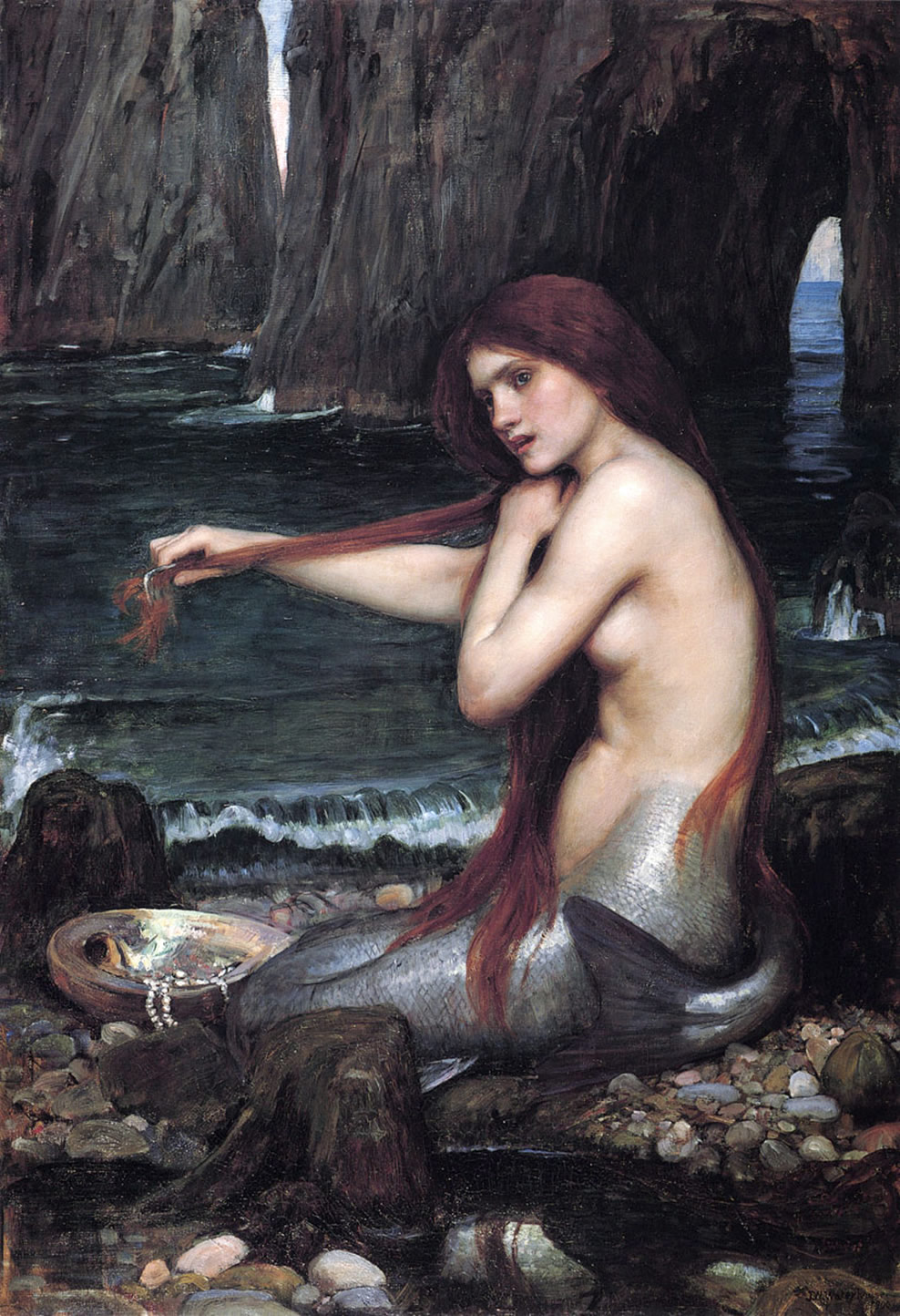
Sky News recently reported that Israel “is in the grips of mermaid fever after numerous sightings of the mythical sea creature off its coast.”
According to the report: Kiryat Yam municipality, near Haifa, says it has been told of dozens of sightings in the past few months.
“Many people are telling us they are sure they’ve seen a mermaid and they are all independent of each other,” council spokesman Natti Zilberman told Sky News.
Israeli officials are taking the matter seriously, and one town council “is offering a $1m (£609,000) reward to anyone who can prove the existence of a mermaid in its waters.”
There is a long history of mermaids existing in folk tales and traditions around the world, and in some ways, news of a teenage-looking “mer-woman” flipping around the coastal waters of Israel isn’t anything new, with reports of mermaids dating back several centuries at various locales around the world.
Indeed, mermaids have received the greatest amount of press in fiction, although in addition to fairy tales (as opposed to fish tails) dating back to times before the last century, in 1919 H.P. Lovecraft wrote his horror story Dagon about mer-creatures “damnably human in general outline despite webbed hands and feet, shockingly wide and flabby lips, glassy, bulging eyes, and other features less pleasant to recall.” According to Lovecraft scholars, the story was inspired in part by a dream he had. “I dreamed that whole hideous crawl, and can yet feel the ooze sucking me down!” he later wrote. Critic William Fulwiler also cites Irvin S. Cobb’s “Fishhead”, a story about a strange fish-like human, as an influences, although he also suggested that Lovecraft’s theme of “an ancient prehuman race that will someday rise to conquer humanity” was borrowed from Edgar Rice Burroughs’ At the Earth’s Core from 1914.
Wherever the theme may have come from, in all likelihood, Lovecraft must have borrowed the name Dagon from the same word the ancient Philistines used for their half-man half-fish God. Looking into this etymology, the name “Dagon” is derived from an earlier word, “dag”, which means “fish” (although the similar Ugaritic root “dgn” also means “grain”, lending to associations between Dagon and grain in many other Semitic cultures). Dagon’s worshippers revered their deity, although in reality, scholars believe the symbol of a fish in human form was really meant to represent fertility, as well as “the vivifying powers of nature and reproduction.” Their have also been discoveries of the fish-god in the sculptures found in Nineveh, Assyria.
Perhaps one of the most interesting of all ancient encounters between man and man-fish in ancient times deals with the Babylonian “Oannes”. According to ancient Babylonian history, this myth involves beings who emerged from the Erythraean Sea that were “part man and part fish”. They adopted the deity into their culture, as evidenced by statues and relics dating back to their earliest recorded history.
The Babylonian writer Berossus in the 3rd century BC was first to write of these mythical beings, crediting they with teaching wisdom to mankind. Berossus described the Oannes as “having the body of a fish but underneath the figure of a man.” The Oannes were described as dwelling in the Persian Gulf, and rising out of the waters in the daytime and furnishing mankind instruction in writing, the arts and the various sciences. While on land, it was said that the Oannes “would take no food in that season,” and every evening they would return to the murky depths of their watery abode in the Gulf.
Many interesting theories regarding the identity of the Oannes have been discussed over the years. One of the more popular anthropological notions involves the Abgallu, who were believed by some scholars to be seafarers aboard a ship from the Indus River Valley/Mohenjo Daro civilization. In this scenario, the fishlike appearance is explained as “some sort of chain mail or sewn discs worn as armor in most cultures.” On the other hand, some have suggested that anything emerging from the water might be likened to fish, and therefore the description of the Oannes doesn’t rule out diving or space suits, perhaps with glass apertures that allowed the faces of those who donned them to remain visible, much like NASA’s spacesuits of today. Following this chain of thoughts, could the Oannes have been alien beings, similar to the silver-suited “humanoids” witnessed beneath Lake Baikal in the 1980s by Russian Navy divers?
We share a long history with the mer-folk of fiction and folklore, and yet seldom do we stop to consider the real possibilities that may surround their existence. Therefore, take heed, lest ye be struggled away into the depths by a scaly man-fish the likes of this one:


