



Legions of Immortal Hydrozoan Invading Earth’s Oceans
Simply put, a peculiar variety of tiny jellyfish whose origins stem from the toasty waters of the Caribbean are slowly extending their habitat to oceans all around the world.
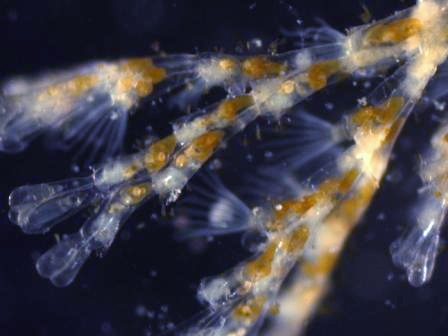
There is really nothing very anomalous about the manner in which Turritopsis nutricula, a five-millimeter jellyfish more correctly associated with the hydrozoan family of small, predatory hydra-like Cnidaria, has begun to propagate other bodies of water around the world. In fact, the creatures themselves are doing very little, aside from being swept into the ballast water in ships, which is emptied at different locations as these vessels dock at ports while traveling. But the peculiar aspect that would garner our attention regarding these odd little buggers is how they are able to reverse their aging process after reaching sexual maturity; a process which they are able to render again and again indefinitely. This presents a curious situation where the creatures never really die, and are thus considered to be biologically immortal.
The Times Online recently cited these jellies as being “the world’s only ‘immortal’ creature”, but in truth there are a variety of similar creatures which maintain biological immortality in this way. A variety of different bacteria, hydra, and other jellyfish also are able to maintain cellular animation which doesn’t appear to be limited by the Hayflick limit.
The Hayflick limit by definition is the number of times a cell will be capable of dividing before it stops, due to the cellular chromosomes’ telomere reaching a critical length. Telomeres could be thought of as “disposable buffers” that block the ends of individual chromosomes, and having been likened to “shoelace aglets”, telomeres are normally consumed during the process of cell division. However, in some instances the telomeres are capable of being replenished by a particular enzyme appropriately called the telomerase reverse transcriptase (often shortened to merely telomerase). In clinical studies, even cancer cells might be considered “immortal” due to the fact that they have been found to produce this potent enzyme, which might tell us something about the voracity of the disease in its advanced stages.
But on a lighter note, the Times reports that these curious properties of the Turritopsis nutricula are now becoming the focus of research by marine biologists and geneticists, stating that “The switching of cell roles is usually seen only when parts of an organ regenerate. However, it appears to occur normally in the Turritopsis life cycle.” In what ways might the medical industry benefit from such studies; or on the other hand, in what ways imaginable could such research drum up controversy, much like studies involving controversial stem-cell research has done in the past? Could research into how Turritopsis rejuvinates itself lead to future similar applications for humans as well?
No Comments
No comments yet.
RSS feed for comments on this post. TrackBack URL
Sorry, the comment form is closed at this time.


